
Reverse Engineer Thinking
Why emerging filmmakers must stop treating distribution as the final step and start building market viability into the story from the beginning.

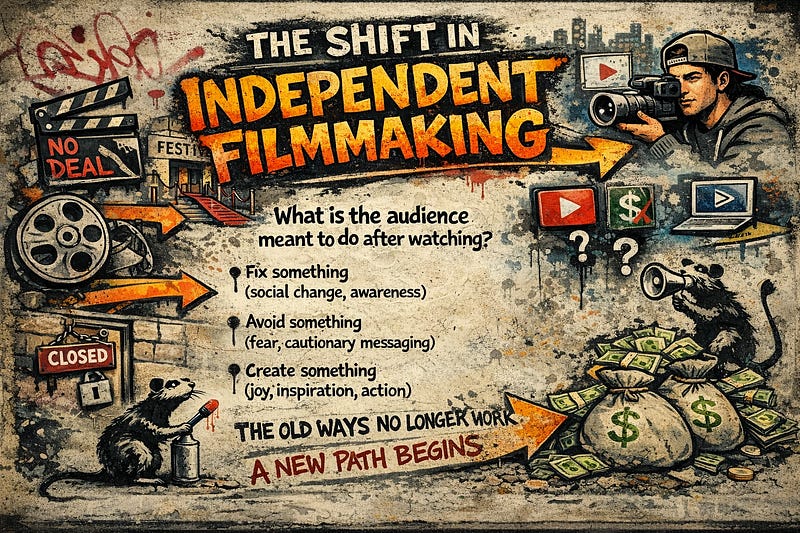
Aspiring and newly emerging independent filmmakers need to know where their content is going to live before manifesting their idea.
Gone are the days of relying solely on traditional processes to obtain distribution for independent cinema.
For decades, the model has remained largely the same: generate intellectual property (IP), develop it through attachments and financing, take it through the festival circuit, and hope for acquisition or distribution — either through theatrical release or major streaming platforms with marketing support to generate ROI.
This model still works — for those already inside the system.
But for newly established filmmakers, it is no longer a reliable path forward.
A shift has occurred.
Not entirely new — but a necessary evolution.
And let’s be clear: this shift in the filmmaking process I am referring to is not the same as what is known as Non-Dependent Filmmaking.
If you’re unfamiliar, Non-Dependent Filmmaking operates outside the major studio system, often utilizing extremely low budgets and non-formulaic storytelling — what I simply describe as a modern-day “French New Wave,” era of filmmaking.
Non-Dependent Filmmaking is efficient as it offers undeniable advantages such as creative control, flexibility in team-building, and artistic freedom.
However, its limitation lies in sustainability.
While a project may secure a niche VOD release or limited arthouse exhibition — and in rare cases breakeven — it rarely generates the consistent returns needed to support a long-term filmmaking career. Without backend profitability, filmmakers are often reset to zero with each new project.
So if the goal of the aspiring and newly emerging independent filmmaker is to build a sustainable career — not just complete one feature film and go into dentistry — another approach must and or should be considered in my opinion.
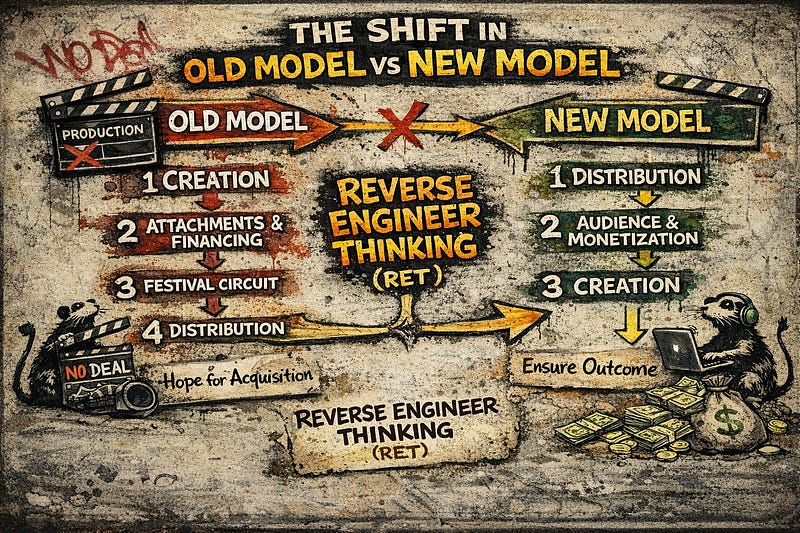
The Shift I am referring to is what I call Reverse Engineer Thinking (RET).
The traditional model starts with creation and hopes for distribution whereas RET starts with distribution and generates creation.
So, what is RET?
Reverse Engineer Thinking is a filmmaking which breakdown strategy that begins with understanding distribution, audience, and monetization — then builds the story backwards to ensure market viability.
It is, at its core, a business plan for narrative development with one goal in mind — monetization.
You have an idea. Great.
But filmmakers need to stop viewing their ideas solely as passion projects — and start viewing them as marketable, necessary products.
Because time invested does not equal market relevance.
That is what RET is designed to evaluate.
The RET steps are found below — I how they help you reframe your thinking in the best way possible:
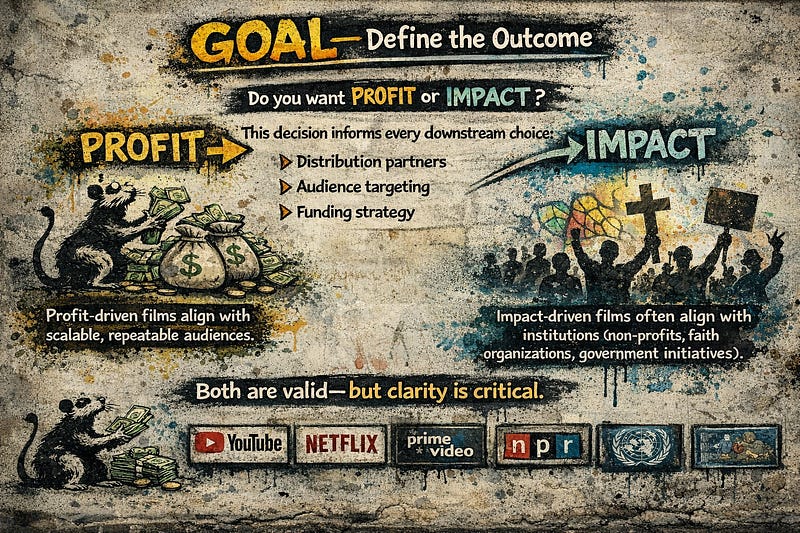
1. GOAL — Define the Outcome
Do you want profit or impact?
Imagine your IP is manifested and one the platform of your dreams and people are consuming it — as a result, what do you truly want?
Profit or Impact / an ROI or Walk the Red Carpet / Money or the Spotlight?
You can only choose one. Now choose and stick with it.
The GOAL of the filmmaker is the anchor point of RET as it determines the definition of success before anything is created.
Whether the film is profit-driven or impact-driven will directly influence every downstream decision, from who the audience is to how the film is funded and ultimately distributed.
A profit-driven goal requires scalable audiences, repeatable concepts, and clear monetization pathways, which will shape the HOUSE and LANE toward efficiency and volume.
An impact-driven goal, on the other hand, will refine the AUDIENCE into specific communities or institutions and align the MISSION toward measurable change.
Without clarity at the goal level, every other category becomes guesswork, and the system collapses into the very uncertainty RET is designed to eliminate.
The trick here is when the filmmaker is aware of their true goal and they use it as a compass during the development of their IP which goes something like this, “Does this little or big decision I have to make getting me closer or further way from my true goal?” They will end up with a result which yields both profit and impact.
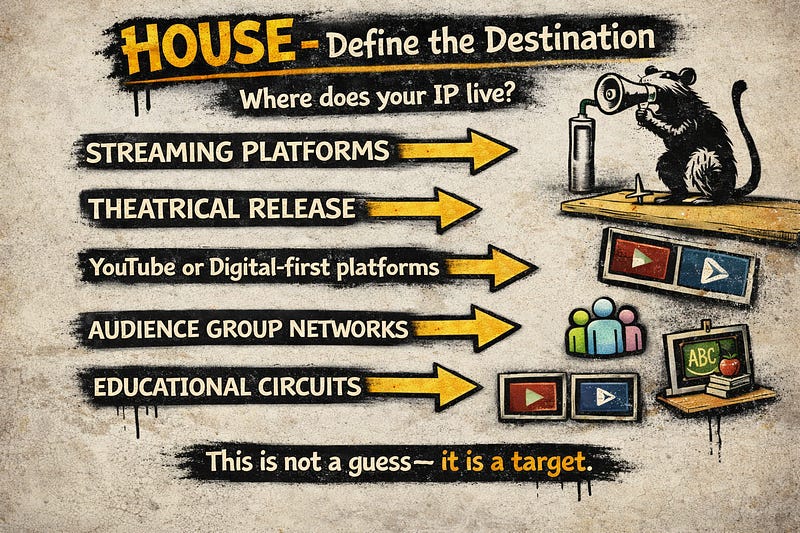
2. HOUSE — Define the Destination
Where does your IP live?
Imagine your IP is manifested and one the platform of your dreams and people are consuming it — where do you go to find it?
At Regal Cinemas / On DramaBox / Disney+ / the list goes on.
You can only choose one. Now choose and stick with it.
The HOUSE defines where the film will ultimately live, making it the first real-world constraint that shapes the project.
By identifying a specific distribution endpoint — whether streaming, theatrical, YouTube, or institutional networks — you immediately begin refining the AUDIENCE and narrowing the LANE.
For example, a film intended for a niche streaming platform will require different pacing, runtime, and production scale than one designed for theatrical release.
The HOUSE also informs FUNDING, because investors and partners need clarity on where the project will generate returns or impact. In this way, the HOUSE transforms distribution from a hopeful outcome into a fixed target, forcing every creative and logistical decision to align with its requirements.
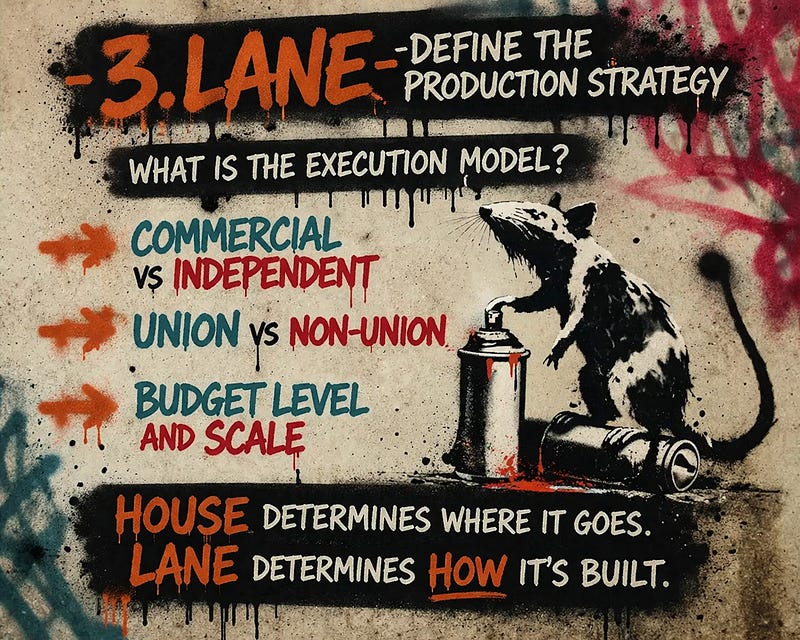
3. LANE — Define the Production Strategy
What is the execution model?
Imagine your IP is manifested and one the platform of your dreams and people are consuming it — who built it?
A24 / Warner Bros / Pixie USA / the list goes on.
You can only choose one. Now choose and stick with it.
The LANE determines how the film is physically built, but more importantly, it ensures that execution aligns with both the HOUSE and the GOAL.
A mismatch here is where many independent films fail — overbuilding for a distribution platform that cannot support the budget, or underbuilding for an audience that expects higher production value.
The LANE refines FUNDING by establishing realistic capital requirements and shapes the NARRATIVE by defining what is achievable within those constraints. It also reinforces the AUDIENCE, as production style, casting, and scale must resonate with the expectations of that specific group.
In RET, the LANE is not about creative limitation — it is about strategic precision.
HOUSE determines where it goes.
LANE determines how it’s built.
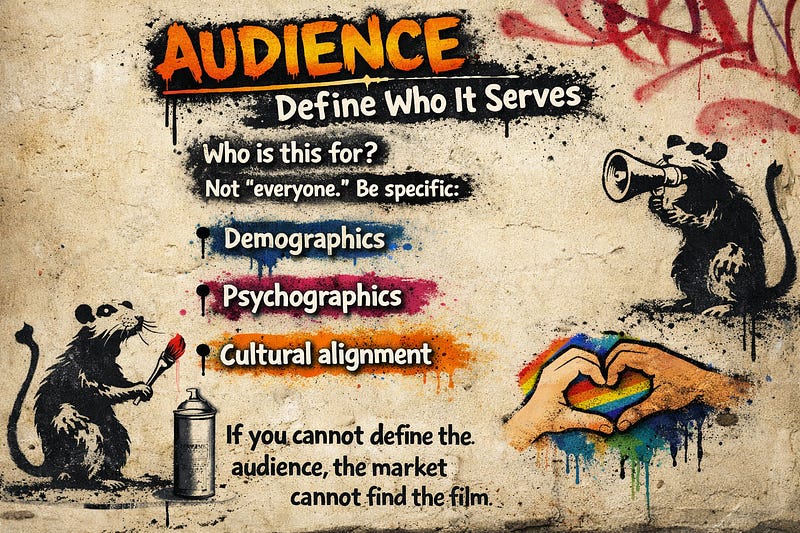
4. AUDIENCE — Define Who It Serves
Who is this for?
Imagine your IP is manifested and one the platform of your dreams and people are consuming it — who is your audience demographic?
Children (ages 8–12) / African American Women (ages 40–60) / Veterans from World War II / the list goes on.
You can only choose one. Now choose and stick with it.
The AUDIENCE is the bridge between the business and the story, transforming the project from a general idea into a targeted product.
By clearly defining demographics, psychographics, and cultural alignment, the filmmaker creates a direct pathway to monetization and engagement.
The AUDIENCE sharpens the MISSION by clarifying what emotional or intellectual need is being fulfilled, and it influences the THEME by determining how that message should be communicated. It also directly impacts FUNDING, as investors and partners are far more likely to support a project with a clearly identifiable and reachable market.
Without a defined audience, the HOUSE has no target, the LANE has no direction, and the film has no market relevance.
If you cannot define the audience, the market cannot find the film.
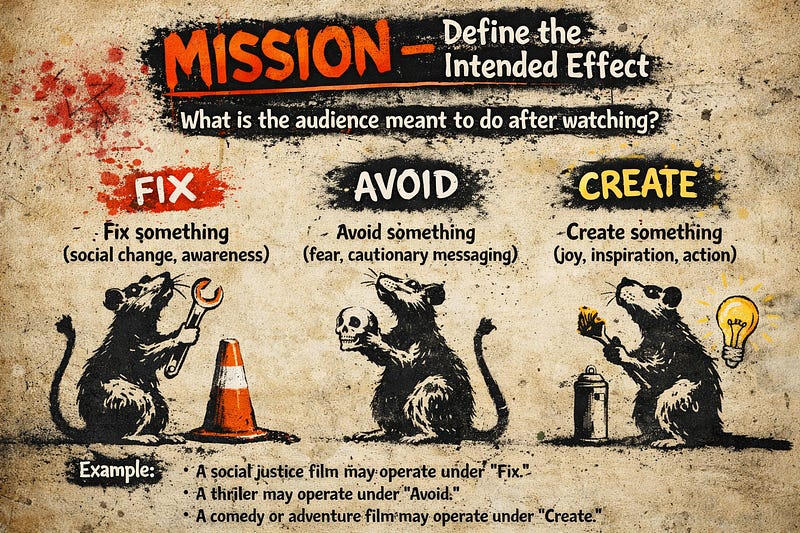
5. MISSION — Define the Intended Effect
What is the audience meant to do after watching?
Imagine your IP is manifested and one the platform of your dreams and people have consumed it — what does your audience do next?
Storm the Capital / Give a Stranger a Hug / Fund the Sequel / the list goes on.
You can only choose one. Now choose and stick with it.
The MISSION articulates what the film is meant to do to the audience after they experience it — whether that is to fix, avoid, or create.
This is where intention becomes measurable, turning storytelling into a functional tool rather than a passive experience.
The MISSION refines the AUDIENCE by ensuring that the intended effect matches the needs of that group, and it shapes the THEME by determining whether the story should inform, challenge, or entertain. It also strengthens CORE DNA alignment, as organizations and partners are drawn to projects that clearly reflect their own objectives.
When the MISSION is clear, the film becomes actionable, which is essential for both impact and monetization.
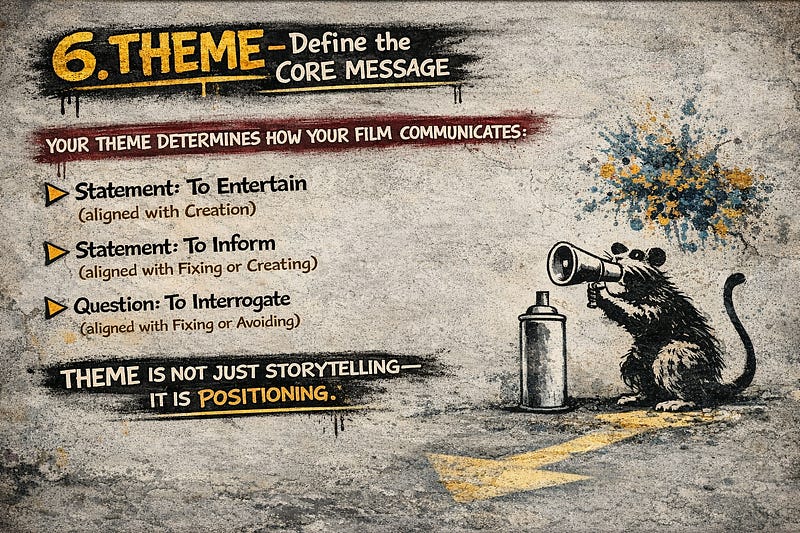
6. THEME — Define the Core Message
How is the MISSION felt by the audience through the narrative?
Imagine your IP is manifested and one the platform of your dreams and people are consuming it — is it escapist, educational, or pondering?
Escapist: Entertaining with Spectacle / Educational: Informative with Statistics / Pondering: Questioning the Facts
You can only choose one. Now choose and stick with it.
Your THEME determines how your IP communicates positioning.
By deciding whether the film will entertain, inform, or interrogate, the filmmaker ensures that the message aligns with both the MISSION and the AUDIENCE.
The THEME influences the NARRATIVE by guiding tone, character arcs, and dialogue, while also reinforcing CORE DNA partnerships by signaling what the film stands for. A clearly defined theme also ensures consistency across all aspects of the project, making it easier to market, fund, and distribute.
Without thematic clarity, the film risks becoming fragmented, weakening its ability to connect with its intended audience.
Theme is not just storytelling — it is what the filmmaker is trying to say about the discovery of themselves, their perspective on the experience of life or their understanding of their influence on the world or lack thereof.
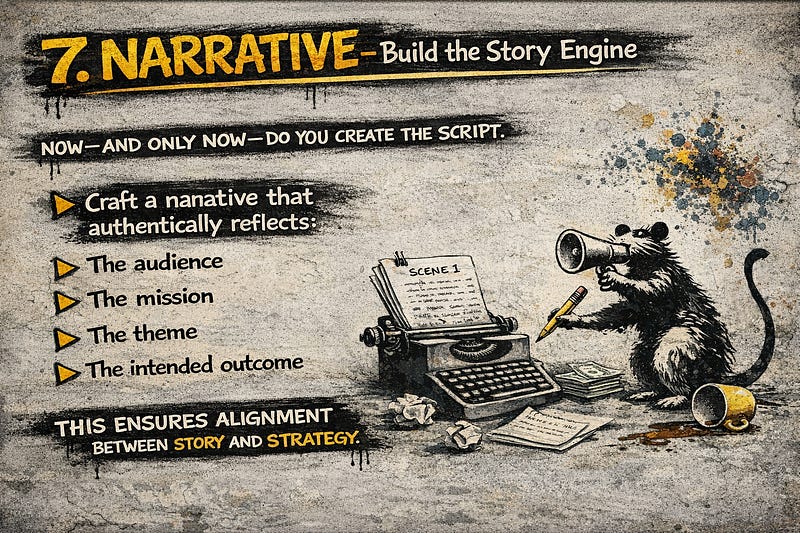
7. NARRATIVE — Build the Story Engine
Now — and only now — do you create the IP.
Imagine your IP is manifested and one the platform of your dreams and people are consuming it — this is the first step of manifestation.
A Novel / A Movie / An in-person experience / the list goes on.
You can only choose one. Now choose and stick with it.
Only after the previous elements are defined does the NARRATIVE come into play, ensuring that the story is not just creatively compelling but strategically aligned.
The narrative must embody the AUDIENCE, execute the MISSION, and communicate the THEME, all while fitting within the constraints of the LANE and the expectations of the HOUSE.
This alignment transforms the script into a functional asset rather than a speculative one. The NARRATIVE also impacts FUNDING, as a well-aligned story is easier to pitch and justify, and it lays the groundwork for FRANCHISE potential by establishing a world and concept that can expand beyond a single film.
This ensures alignment between story and strategy.
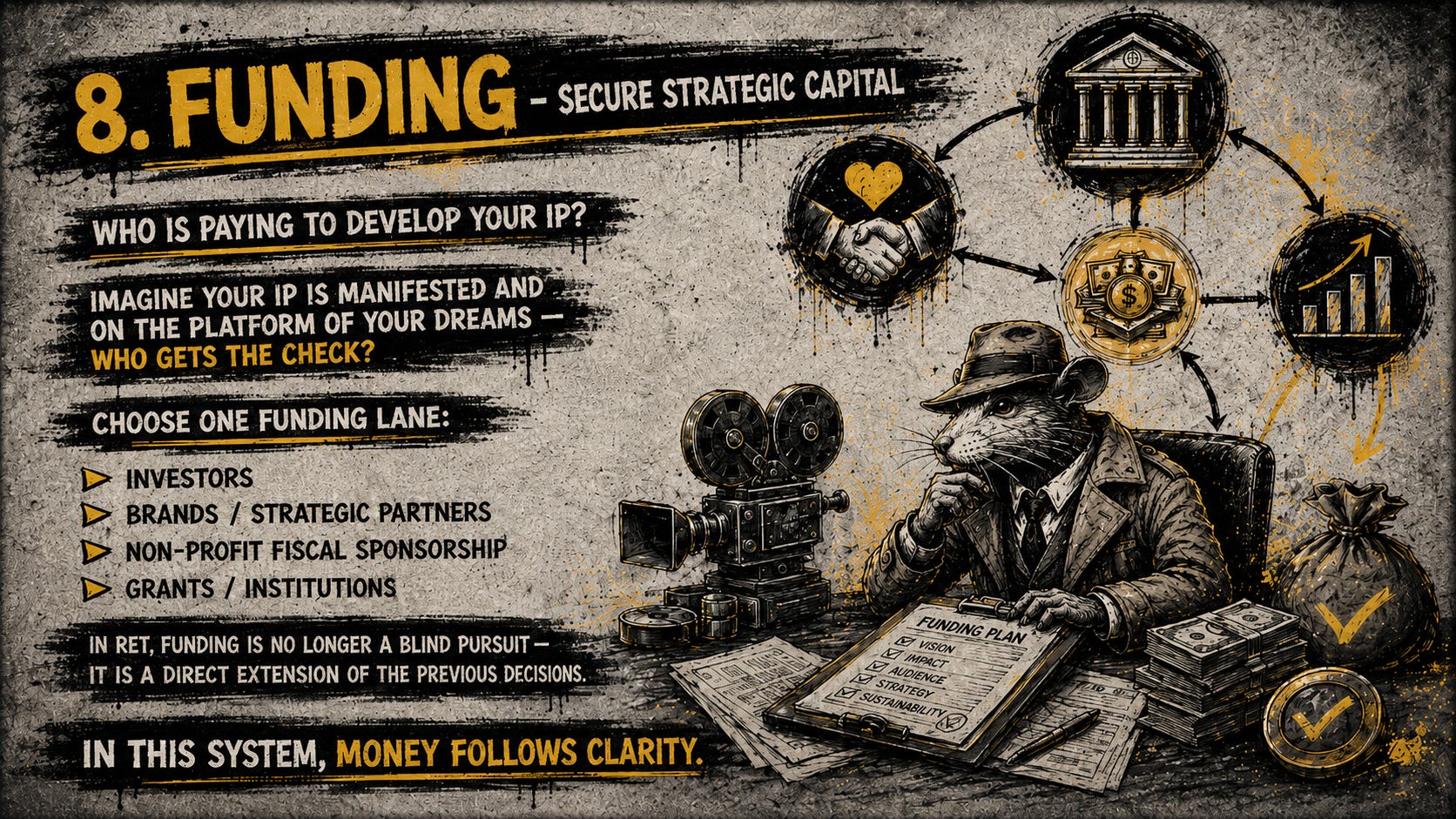
8. FUNDING — Secure Strategic Capital
Who is paying to develop your IP?
Imagine your IP is manifested and one the platform of your dreams and people are consuming it — who gets the check?
Chick-fil-A / Plan B Entertainment / Non-Profit Fiscal Sponsorship / the list goes on.
You can only choose one. Now choose and stick with it.
In RET, funding is no longer a blind pursuit — it is a direct extension of the previous decisions.
Because the GOAL, HOUSE, AUDIENCE, and MISSION are clearly defined, the filmmaker can identify funding sources that are naturally aligned with the project.
For example, investors seek profit-driven scalability, while grants, non-profits, and institutions support impact-driven initiatives.
This clarity increases efficiency and reduces wasted effort. FUNDING also reinforces the LANE by setting realistic production boundaries and strengthens CORE DNA by attracting partners who see the film as an extension of their own objectives.
In this system, money follows clarity.
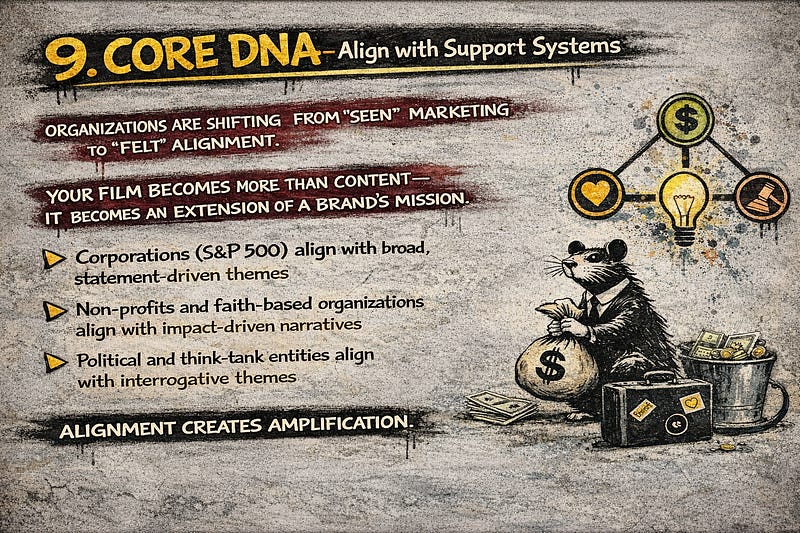
9. CORE DNA — Align with Support Systems
Organizations are shifting from “seen” marketing to “felt” alignment.
Imagine your IP is manifested and one the platform of your dreams and people are consuming it — How is the MISSION of the IP aligned with the mission of the organization supplying your funding?
Chicken Sandwich Purchase = Togetherness / Brad Pitt = Supporting Unique Voices / Tax Deductions = Community Improvement
You can only choose one. Now choose and stick with it.
The CORE DNA represents the alignment between the film and external entities that can amplify its reach and impact.
When a film’s GOAL, MISSION, and THEME are clearly defined, it becomes easier for organizations — whether corporate, non-profit, or political — to see themselves within the project.
This alignment creates built-in marketing, distribution pathways, and credibility.
CORE DNA strengthens the HOUSE by expanding distribution opportunities and enhances FUNDING by attracting strategic partners rather than passive investors. It also reinforces the AUDIENCE, as these organizations often bring their own communities into the ecosystem.
Alignment creates amplification. Amplification creates awareness. Awareness creates value.
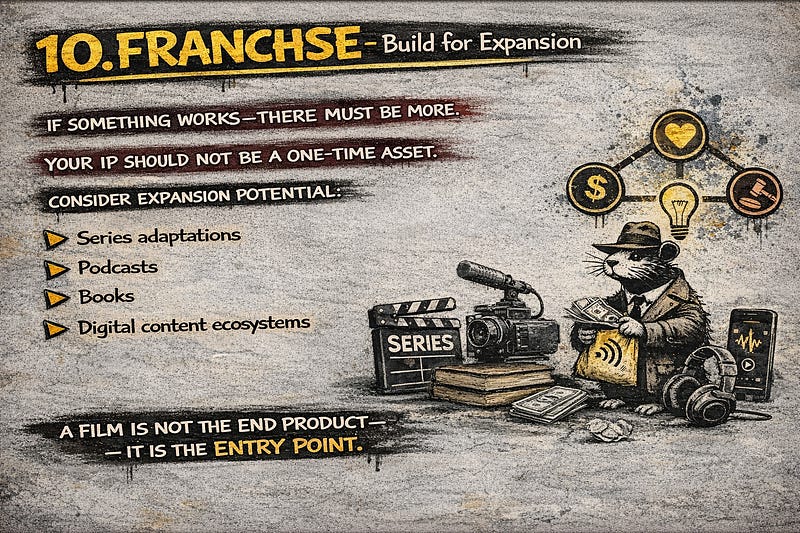
10. FRANCHISE — Build for Expansion
How is your IP designed to become more than what it currently designed as?
Imagine your IP is manifested and one the platform of your dreams and people are consuming it — what other mediums can we experience it through?
As a graphic novel / As a videogame / As a theme park ride / the list goes on.
You can only choose one — for the time being. Now choose and stick with it.
The FRANCHISE component ensures that the film is not treated as a one-time product but as the foundation of a larger ecosystem.
By considering expansion from the outset, the filmmaker creates additional revenue streams and long-term sustainability.
This step is informed by the AUDIENCE, the NARRATIVE and the GOAL.
A strong franchise strategy also makes the project more attractive during FUNDING and CORE DNA alignment, as partners are more likely to invest in something with long-term potential.
In RET, the film is not the end — it is the beginning.
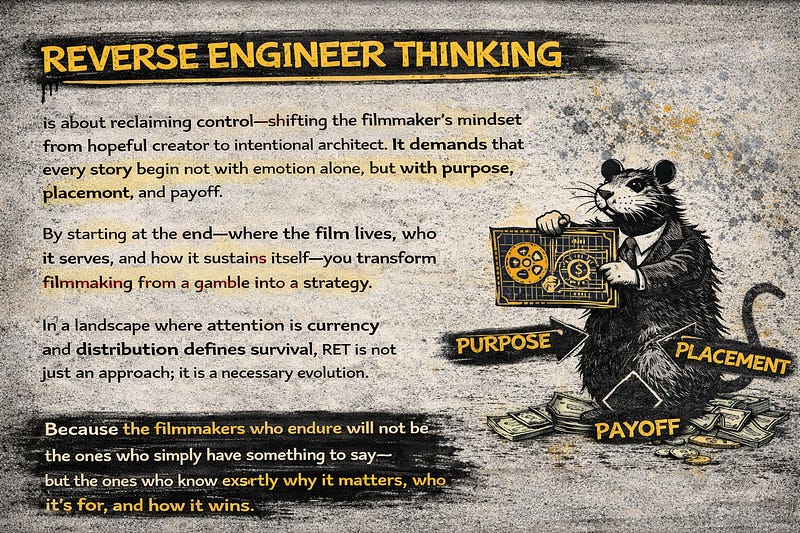
Closing Note — The RET Loop
Reverse Engineer Thinking is not a linear checklist — it is a closed-loop system designed for continuous refinement.
At its core, RET operates as an iterative cycle:
GOAL → HOUSE → LANE → AUDIENCE → MISSION → THEME → NARRATIVE → FUNDING → CORE DNA → FRANCHISE → Back to GOAL refinement
Each step does not simply lead to the next — it informs, challenges, and sharpens the ones before and after it.
As new information is introduced — whether through audience feedback, funding realities, or distribution shifts — the system loops back on itself, forcing recalibration.
A change in GOAL may redefine the AUDIENCE. A constraint in FUNDING may reshape the LANE. A discovery in CORE DNA alignment may expand the HOUSE.
This is where RET separates itself from traditional filmmaking models.
Traditional models move forward and hope for alignment at the end whereas RET builds alignment from the beginning — and continuously pressure-tests it.
The loop ensures that nothing exists in isolation. Every decision must justify itself within the ecosystem:
If the AUDIENCE shifts, does the MISSION still hold?
If the HOUSE changes, does the LANE still make sense?
If the NARRATIVE evolves, does it still serve the GOAL?
This constant recalibration is what transforms filmmaking from a one-time creative act into a sustainable system.
Because in today’s landscape, success is not just about making a film — it’s about building a repeatable process that consistently lands.
RET is that process.